
Tropical Macroalgal Cultivation for Bioconversion to Methane
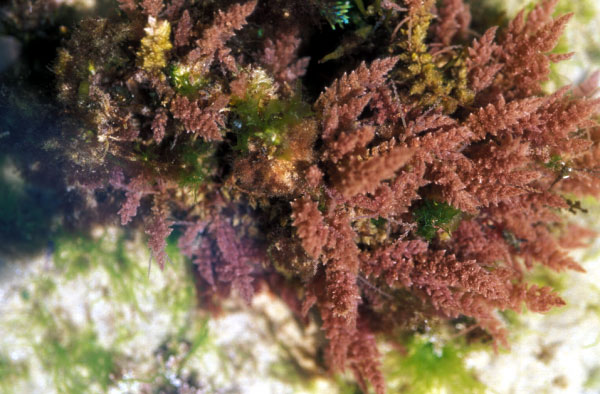
Several.concepts have been developed for tropical marine biomass cultivation for bioconversion to methane. These concepts take advantage of Florida's large areas of relatively shallow water. One concept, tidal flat seaweed farms, uses currently available macroalgal candidates (Gracilaria, Ulva) and at biomass yields of 12-25 dry ash free tons/hectare-year can-provide delivered low feedstock costs of · $40-25/DAFT, or on an energy basis, $3.60-2.30/G joule, respectively. These biomass yields are close to those achieved in commercial Gracilaria culture in Taiwan. Such systems would be constrained to nearshore waters of 0.5-1.5 m in depth, of which there are 190,000 hectares in northwestern Florida.
Concepts which would work in deeper waters (from 1.5-20 m depths) use floating seaweeds. Such biomass species would need to be produced by genetic breeding and hybridization, as there is not an adequate natural species available which also has high bioconversion rates. Such hybrids may be intrageneric ones of Sargassum, or Sargassum hybrids with other algae such as Macrocystis. A biotechnology approach could provide competitive feedstock costs with a large potential gas production, as there is approximately 1,900,000 hectares between 1.5-20 m depths in northwestern Florida.



Marine Agronomy Group, CAFNRM, UH-Hilo
200 W. Kawili st., HI 96720, USA
Contact: Marine.Agronomy.Group@gmail.com
Funding for this web portal is provided by the World Wildlife Fund and the University of Hawaii-Hilo.